Previous Programs
Home / Programs / Previous Programs
Project 1
Enhancing Women’s Involvement in Briquette Production and Marketing as an Alternative Source for Clean Energy to Charcoal and Firewood in Uganda
NAWAD implemented an 18-month project on “Enhancing women’s involvement in briquette production and marketing as an alternative clean energy source to charcoal and firewood in Uganda.” The project was supported by the International Development Research Centre (IDRC) through the Aspen Network for Development Entrepreneurs (ANDE). The project targeted four female-owned briquette enterprises in the districts of Mpigi, Wakiso and Mukono in the Greater Kampala Metropolitan Area (GKMA). The overarching goal of this research was to improve women participation in clean energy production and marketing through the deployment of gender-inclusive briquette infrastructure to increase availability and access to briquettes for cooking. This was very critical for Uganda’s clean energy transition since the current briquette technology is intensive labor, which is disadvantageous to the women. The research answered the question of “How can women’s involvement in the briquette value chain be harnessed to reduce gender bias and increase their participation and pay in the sector?” The project addressed this question through the deployment of gender-inclusive briquette infrastructure targeting women-owned enterprises in the Greater Kampala metropolitan area (GKMA).
The main objective was to design and deploy gender-inclusive briquette machinery to promote women’s participation in the clean energy transition. The specific objectives were: Assess women’s involvement in the briquette value chain; Characterize potential alternative raw materials to charcoal dust with the intent to recommend the most potential alternatives for briquette production; Promote women’s participation in briquette production through the deployment of gender-inclusive briquette infrastructure; Strengthen the capacity of briquette enterprises on the use of gender inclusive machinery and marketing of briquettes for increased competitiveness.
It involved the design and deployment of gender-inclusive briquette machinery, stove manufacturing, and capacity building of briquette machinery users with a focus on briquette production, briquette drying, and marketing.
Key Project Achievements
Women-led enterprises trained
Dual power gender inclusive briquette machinery installed
Briquette dryers constructed
Project Surveys conducted(Baseline and Endline)
Webinar convened
Stakeholders on clean energy engaged
Briquette enterprises supported
Blog published
Project 2
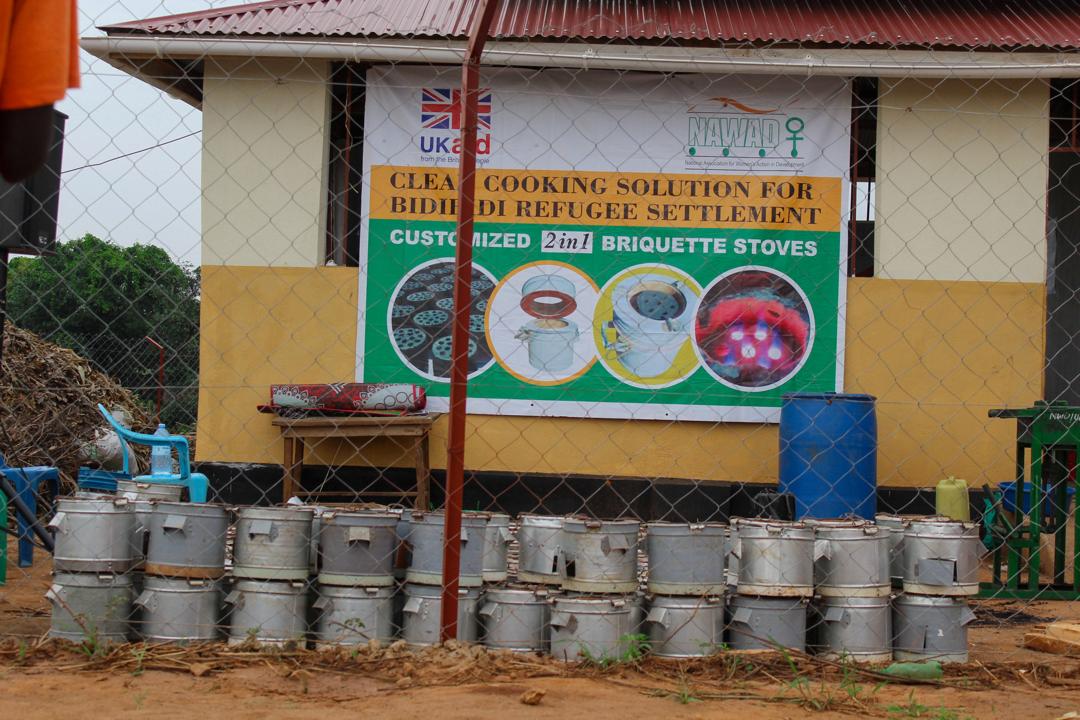
Clean Cooking Solution for Bidibidi Refugee Settlement
With support from the Foreign, Commonwealth and Development Office (FCDO) through UKAID, the National Association for Women’s Action in Development (NAWAD) implemented a Clean Cooking Solutions Project in Bidibidi Refugee Settlement from May 2024 to December 2025. The project targeted 300 beneficiaries, 70% refugees and 30% host community members.
The main objectives of the project were to: increase the availability of clean cooking fuels by producing and distributing briquettes as an alternative to traditional firewood; reduce the use of woody biomass and non-fuel-efficient cookstoves among refugee and host communities; create employment opportunities for both refugees and host community members along the briquette and cookstove value chains; and reduce the burden of firewood collection, enabling women and children to engage more in productive and educational activities.
To achieve these objectives, NAWAD undertook a number of activities, including; stakeholder engagement, baseline survey, establishment of briquette production centers with gender inclusive briquette machinery and customized stove manufacturing facilities, training of refugees and host community members in briquette production, gender awareness, environmental conservation, technology dissemination, and community sensitization on clean energy options. A high-level dissemination workshop was also held.
Key Project Achievements
People trained in Bidibidi
Female clean-energy trainees
Male clean-energy trainees
Briquette production centres established
Efficient cookstoves distributed
Young people reached
Peer educators trained
District leaders, refugee welfare council and OPM team engaged
Project 3
Promoting Community-Based Women-Led Climate Justice Solutions in Agriculture in Nwoya
Promoting Community Women-led Climate Justice Solutions in Agriculture (PROCOWCA) was a three-year project (2021/2024) funded by the Global Fund for Women. The project aimed at strengthening grassroots eco-feminist movements through promotion of promoting Community Women-led Climate Justice Solutions in Agriculture The main objective of the project was to improve food security and household incomes among the targeted household to promote climate change adaptation, and mitigation in Nwoya district. The main activities involved training of women in climate-smart agricultural technologies and practices. The project targeted 40 women groups, including 600 smallholder women farmers, youth and persons living with disabilities.
The project encouraged women to lead the way in environmentally sustainable agriculture while advancing their economic rights and building community resilience to climate change. The project expanded income options by introducing beekeeping (Apiary) and training women in modern hive management.
Project Documentary
Key Achievements
Women in Nwoya received jackfruit seedlings to promote agroforestry.
Women groups reached
Documentary published
Project 4
Building A Feminist Youth-Led Movement to Promote Access to Youth-Friendly SRH Services
NAWAD implemented the project on “Building a Feminist Youth-Led Movement to Promote Access to Youth-Friendly Sexual and Reproductive Health (SRH) Services” in Wakiso and Nwoya (March 2024–March 2025). The initiative targeted young people (13–30 years) in- and out-of-school, to strengthen their leadership skills, feminist organizing, and access to youth friendly Sexual and Reproductive Health Rights (SRHR) services as part of the wider social justice work. Selected young people were trained as peer educators to lead awareness campaigns, facilitate dialogues, and share referral pathways for youth-friendly services. We engaged parents as caregivers to communicate more openly and safely with young people on SRHR, reduce stigma to create an enabling and safe space for informed decision-making.
Project Documentary
Key Project Achievements
Youth reached through youth-focused leadership, empowerment and social justice programming.
Parents (Wakiso) trained to discuss SRHR with youth.
Youth (Nwoya & Wakiso) trained as peer educators.
Documentary produced Toll-free line established to reduce barriers to reporting and guidance.
Baseline Survey conducted
District stakeholders engaged
National stakeholders convened
Youth-led petition submitted
Project 5
NDP III Agro Industrialization Implementation Action Plan and Women Financial Inclusion projects
Over the years, NAWAD implemented targeted interventions such as the NDP III Agro Industrialization Implementation Action Plan and Women Financial Inclusion (AINAPI III) Projects (2022-Jan 2025), in Mbarara and Rubirizi (South Western region of Uganda). These projects were supported by the United States Agency for International Development (USAID) through the East West Management Institute (EWMI) Civil Society Strengthening Activity (CSSA). The core objectives were: Targeting women smallholder farmers to reduce post-harvest losses and improve the quality and marketability of their produce; Enhancing women farmers’ access to crucial extension services, modern post-harvest technologies, and storage facilities; Fostering the active participation and integration of women smallholder farmers into major national wealth-creation initiatives, specifically the Parish Development Model (PDM).
Under the projects, women smallholder farmers were equipped with smartphones and ICT training to help them seamlessly access agricultural extension resources, weather data, and market information. The project educated female farmers on local government planning, budgeting processes, and advocacy frameworks to champion their economic rights. Additionally, the project enhanced NAWAD’s internal structures by updating their Strategic Plan (2023-2025), finance policies, procurement policies, advocacy strategies, communication frameworks, and board governance charters to ensure long-term sustainability. NAWAD delivered practical training to strengthen smallholder farmers’ financial and agribusiness management skills. We developed a user-friendly financial literacy guide, trained staff to deliver modules, and supported smallholder farmers in building budgeting, saving, investing, and loan acquisition skills. We also supported smallholder farmers to navigate digitized government systems by training them on the Parish Model Development Information System (PDMIS) and facilitated savings groups while linking smallholder farmers to formal services, including Centenary Bank. To strengthen income and market access, we supported value addition through a grain milling initiative with Bunenero Farmers Group and improved mobility and marketing through a tricycle to reduce transport barriers and losses.
Project Documentary
Key Project Achievements
Women Smallholder farmers trained in financial management to strengthen agribusiness sustainability.
Women smallholder farmers gained knowledge of PDMIS, improving access to government services and opportunities.
Women smallholder farmers equipped with skills/tools for income-generating activities and enterprises.
Women smallholder farmers reached
NAWAD’s USAID-funded project Brief
Project 6
Strengthening Community Action Against Sexual and Gender-based Violence
To further contribute to efforts towards gender equality in Uganda, NAWAD, with support from Womankind Worldwide through Her Voice Fund (2022-2023), implemented a project, “Strengthening Community Action against Sexual and Gender Violence” in Nwoya district, targeting two hundred (200) adolescent girls in school and 80 teenage mothers to prevent teenage pregnancies and respond to sexual violence and gender-based violence. The objectives were: To increase access to age-appropriate Sexual and Reproductive Health and Rights information among young women and girls in Nwoya; To increase engagement of social-cultural leaders in GBV prevention and response; To increase income generation among teenage mothers.
As a result, knowledge among young women and girls on their Sexual and Reproductive Health and Rights (SRHR) was enhanced through training and awareness creation. Young women and girls who were reached ably made informed decisions on sexual activities, hence reducing teenage pregnancies in school and risks of contracting Sexually Transmitted Diseases (STDs), including HIV/AIDs, among others. With support from local leaders, NAWAD fueled community transformation against GBV. At the family level, NAWAD used a couple model approach and male agents of change to challenge male supremacy against sexual and gender-based violence.
NAWAD strengthened capacities among teenage mothers through the establishment of teenage mothers’ empowerment clubs, where a total of eighty (80) mothers received livelihood training and skills in poultry keeping, baking, and value addition for their crop yields. Following a group approach, 6 groups of not more than 15 members were established to boost collaboration, learning, and a culture of saving, which strengthened resilience and self- sufficiency among the teenage mothers.
Key Project Achievements
community change agents on SGBV protection and the GBV referral pathways.
Teenage mothers received livelihood training and skills in poultry keeping, baking, and value addition for their crop yields.
Livelihood empowerment clubs were created to enable teenage mothers in Anaka and Purongo sub-counties to improve their income status and enable them to resist and protect themselves from SGBV
Teenage mothers’ groups were supported with baking equipment
NAWAD launched the 16 Days of Activism with a community march in a campaign to raise awareness about GBV, and 100 people marched.
NAWAD conducted a two-day training in SRHR in Anaka Integrated Secondary School with the help of a facilitator
IEC materials with information about SGBV were distributed
Radio-Talk show held
About NAWAD
NAWAD is committed to promoting a stable and peaceful society where women and girls enjoy equal rights with men and boys in the different spheres of life.
Navigation
Navigation
Contact
+256-707274993
+256-760260097
Toll- free: 0800-365-365
nawad@nawad.co.ug
P.O BOX 106555, Kampala-Uganda
Plot 3378; block 223, Kyaliwajjala.
Copyright © NAWAD All Right Reserved